Hello, #Vivers! In the entry that we bring you today, we tell you the origin of a word that I am sure that all students of Spanish courses in Spain have used at some time: the name of the country where they are located.
The origins: Spanía and Hispania
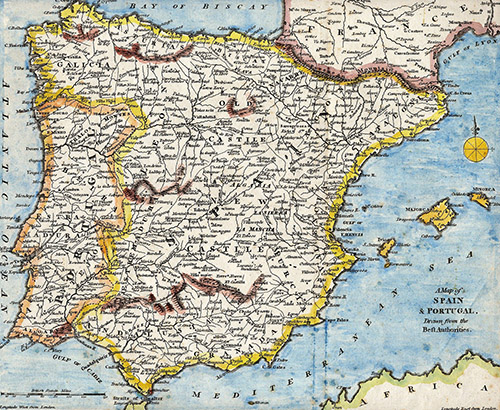 the greek word Spain It is recorded for the first time in the XNUMXst century BC. C. The geographer Artemidorus of Ephesus used it as a variant of the Greek Hispania, which passed into Latin as Hispania. At that same time that name was used by Julius Caesar, who distinguished the Hispanic later, beyond the Ebro River, and the Citerior Hispania, south of the Ebro River. After the union of the kingdoms of Castile and Aragon with the wedding of the Catholic Monarchs, the name of Hispania It began to be used heavily for the country.
The origin of the word is not known with certainty. It is believed that it may come from Punic Isephanim, which in this language spoken by the Phoenicians of Carthage meant “island or coast of rabbits”, because the rabbit was a very abundant animal in Andalusia. The Phoenicians founded the oldest city in the West, Cádiz, 3000 years ago. On Roman coins from the time of King Hadrian, Spain was represented as a seated lady, with a rabbit at her feet. Furthermore, the Roman poet Catullus called the Iberian Peninsula Cuniculosa Celtiberia, which meant more or less “Celtiberia, the Hutch”.
Other possible origins of the word
However, some authors claim that the origin of the word is Celtic, because it is related to the fact that the plain region of the Iberian Peninsula has a shape similar to the palm of the hand, which was called chip in the Celtic language, and it is possible that this is the origin of the word Hispania.
There are also other hypotheses about the origin of the word Spain, although they are less credible. For example, the word chip from the Phoenician language, which meant “hidden, hidden.” It is possible that chip derived from the Hebrew word xaphano (hide), because Spain was a distant and hidden country.
Source: The origin of words. Illustrated etymological dictionary. Ricardo Soca.
If you are interested in studying Spanish courses in Spain, in the Luis Vives Spanish School we offer you Spanish classes for all levels. They will surely adapt perfectly to your needs. Luis Vives Spanish School The best option to learn Spanish in the heart of Madrid!