

Hello, #Vivers! In the entry that we bring you today, we tell you the origin of a word that I am sure that all students of Spanish courses in Spain have used at some time: the name of the country where they are located.
The origins: Spanía and Hispania
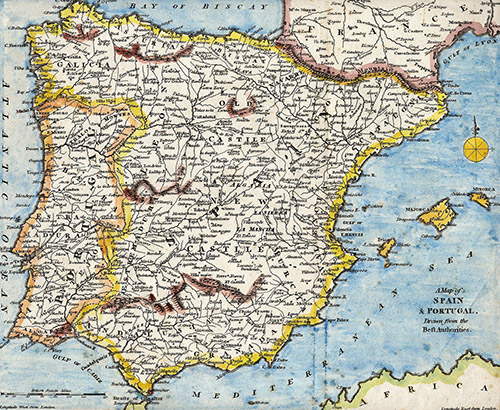 the greek word Spain It is recorded for the first time in the XNUMXst century BC. C. The geographer Artemidorus of Ephesus used it as a variant of the Greek Hispania, which passed into Latin as Hispania. At that same time that name was used by Julius Caesar, who distinguished the Hispanic later, beyond the Ebro River, and the Citerior Hispania, south of the Ebro River. After the union of the kingdoms of Castile and Aragon with the wedding of the Catholic Monarchs, the name of Hispania It began to be used heavily for the country.
The origin of the word is not known for certain. It is believed to derive from the Punic * Isephanim* , which in this language spoken by the Phoenicians of Carthage meant "island or coast of rabbits," because rabbits were very abundant in Andalusia. The Phoenicians founded the oldest city in the West, Cádiz, 3000 years ago. On Roman coins from the time of King Hadrian, Spain was depicted as a seated lady with a rabbit at her feet. Furthermore, the Roman poet Catullus called the Iberian Peninsula *Cuniculosa* Celtiberia , which roughly translates to "Celtiberia, the Rabbit Hutch."
Other possible origins of the word
However, some authors claim that the origin of the word is Celtic, because it is related to the fact that the plain region of the Iberian Peninsula has a shape similar to the palm of the hand, which was called span in the Celtic language, and it is possible that this is the origin of the word Hispania.
There are also other hypotheses about the origin of the word Spain , although they are less credible. For example, the Phoenician word *span* , which meant "hidden, concealed." It is possible that *span* derived from the Hebrew word *xaphano* (to hide), because Spain was a distant and hidden country.
Source: The Origin of Words. An Illustrated Etymological Dictionary. Ricardo Soca.
If you're interested in studying Spanish in Spain, at the Luis Vives Spanish School we offer courses for all levels. We're sure you'll find one that perfectly suits your needs. Luis Vives Spanish School : the best option for learning Spanish in the heart of Madrid!
