New Arrivals

DELE 2024 exam dates
[Updated 2025] ⭐Certify your Spanish with DELE

Hello, #Vivers! If you're learning Spanish and want to obtain official certification of your language level, the Diploma of Spanish as a Foreign Language (DELE) is your best option. This official exam, administered by the Cervantes Institute on behalf of the Spanish Ministry of Education and Vocational Training , assesses skills such as reading comprehension, writing, listening comprehension, and speaking.

📅 The DELE exam dates for 2025 have been published , and here are all the details.

DELE 2025 exam dates

You can apply for any of the following calls. Remember that not all dates include all levels:

  • February 14th 2025
    • Registration until January 8th.
    • Available exams: A2.
  • April 4th 2025
    • Registration until February 12th.
    • Available exams: A1, A2, B1, B2, C1.
  • 23 and 24 of May of 2025
    • Registration until April 9th.
    • Available exams: A1, A2, B1, B2, C1, C2.
      Schoolchildren: A1 and A2/B1.
  • July 11, 2025
    • Registration until May 14th.
    • Available exams: A2, B1, B2, C1.
  • 12 September 2025
    • Registration until July 16th.
    • Available exams: A2.
  • 17th October 2025
    • Registration until September 3rd.
    • Available exams: A2, B1, B2.
  • November 21 and 22, 2025
    • Registration until October 8th.
    • Available exams: A1, A2, B1, B2, C1, C2.
      Schoolchildren: A1 and A2/B1.

Prices and how to register for the DELE 2025 exams

Now that you know the dates, you might want to register. You can do so directly on the official Instituto Cervantes website . Prices vary depending on the level you choose and your country of origin. Check the official website for all the latest details so you don't miss anything.

Is it a good idea to take the DELE exam?

Of course! Certifying your level of Spanish opens many doors:

Spanish nationality: It is a mandatory requirement for some applications.
Studies in Spain: Many universities and programs require it.
Job opportunities: It is an official credential recognized worldwide.
Homologation of studies or procedures such as the MIR.

If you're preparing for the Specific Competency Tests (PCE UNEDasiss) , remember that the DELE isn't the only way to certify your Spanish level. You can also choose the SIELE , among others. Discover the differences between the DELE and SIELE in this related article.

I want to prepare for the DELE exam!

At our school, we offer specialized courses to prepare for the DELE exam at all levels and sessions. Check out our Spanish course options and start preparing today. And if you can't come to our school in Madrid, you can prepare for the DELE exam on our website of specialized online courses, Cursalia.online.

💬 Do you have any questions? Leave your comments below or contact us . We're here to help!

Difference between DELE and SIELE. Luis Vives Spanish School.
Differences between DELE and SIELE

Hello, #Vivers! If you need to certify the level of Spanish you've achieved at the academy, among the different options available, you can choose between the Diplomas of Spanish as a Foreign Language (known as DELE ) or the International Spanish Language Evaluation Service (known as SIELE ). In this article, we'll try to summarize the basic characteristics and differences between the two.

What is the DELE?

In summary, the DELE is an internationally recognized diploma that certifies your level of Spanish, which you have previously chosen to test for (from level A1 to level C2). If you pass the exam, you will receive a certificate for that level. The exam consists of four sections and is administered on paper at an examination center on pre-established dates set by the Cervantes Institute each year.

What is SIELE?

On the other hand, the SIELE is an international accreditation system for your Spanish level in the different language skills (reading comprehension, listening comprehension, written expression and interaction, and oral expression and interaction). It is a multi-level exam that you can take in its entirety (all skills) or just some sections if you only wish to certify partial language skills. The assessment is based on a scale of 0 to 1000 points, where the objective is not to pass or fail, but rather to assess your level in each language skill based on the score obtained (for example, you could obtain a B2 in reading comprehension, B2 in listening comprehension, B1 in written expression, and B1 in oral expression). The levels certified range from A1 to C1. Furthermore, all tests and registration are done online, and you can choose the date and time you wish to take the exam, selecting from the many sessions offered by different examination centers worldwide.

Main differences between DELE and SIELE

In the following table you can see in detail the main differences between DELE and SIELE that the teachers at our academy have indicated to us:

DELESIELE
OwnershipMinistry of Education and Vocational Training of Spain and the Cervantes Institute.Cervantes Institute, National Autonomous University of Mexico, University of Salamanca, University of Buenos Aires.
Mutual recognitionInternational in regulated educational systems (for example, Brazil, France, Italy...), institutions, companies, universities.International of SIELE higher education institutions and other international organizations of reference in education and languages.
Validityindefinite.5 years.
Exam formatOn paper and in writing + oral expression test before an examining board. It is carried out in exam centers accredited by the Cervantes Institute.Exam format On paper and in writing + oral expression test before an examining board. It is carried out in exam centers accredited by the Cervantes Institute. Online, with a computer. The oral test is carried out through recordings. In SIELE accredited exam centers.
Number of exams and levels
  • Six exams for adult audiences: A1-C2.
  • Two school exams: A1-A2/B1.
An exam for adult audiences that includes tasks from level A1 to C1.
Exam tests
  • Reading comprehension.
  • Auditive comprehension.
  • Written expression and interaction.
  • Oral expression and interaction.
  • Reading comprehension.
  • Auditive comprehension.
  • Written expression and interaction.
  • Oral expression and interaction.
Rating systemAppropriate or unsuccessful on the mastery of the level at which the candidate is examined.Spanish knowledge result expressed on a thousand-point scale equivalent to CEFR levels.
Communication of the resultsBetween 2 or 3 monthsmaximum 3 weeks
Certificate that is issued
  • Electronic certification of qualifications with official validity.
  • Official diploma for eligible candidates.
Certificate (complete exam) or Report (only some test/s) of results, depending on the contracted modality.
Calls for applicationsTo obtain your DELE diploma, the Cervantes Institute sets dates that are communicated each year. To find out this year's dates click here.You choose the date and time that best suits you. If you want to take the exam at Luis Vives Escuela de Español, you can see the available dates by clicking here or you can contact us at spanish@luis-vives.es.

At Luis Vives Spanish School, we offer courses to help you prepare for these exams. All of our teachers are highly qualified to prepare students for the DELE and SIELE exams, and most are examiners accredited by the Cervantes Institute, so they can help you achieve your goal. For more information, please email us at spanish@luis-vives.es , send a message to our WhatsApp (+34 660 731 581), or fill out this contact form.

Spanish courses and selectivity
Spanish course + PCE

Hello, #Vivers! Are you planning to study at a Spanish university? At the Luis Vives Spanish School we can offer you a comprehensive solution. Our Spanish and selectivity courses will allow you to improve your level of Spanish and reach the level required to be able to follow the preparation classes for the university entrance test.

Our Spanish and Selectivity course

At the Luis Vives Spanish School, in collaboration with the Luis Vives Study Center, we offer Spanish courses and exam preparation for international students who wish to study at Spanish universities. Our Spanish + University Entrance Exam (Selectividad) courses are designed to help international students first achieve a good level of proficiency in Spanish. Once this level is reached, they can attend preparation classes to pass the PCE (Specific Competency Test, formerly known as Selectividad). This exam is held twice a year: in May and September . It is very important that, in order for an international student to take the UNEDasiss PCE preparation course, they first reach at least a B1 or B2 level of Spanish to be able to confidently take the exam.

So at Luis Vives, we offer you the opportunity to reach these levels of Spanish and prepare for the PCE exam. Our teachers are highly qualified and have extensive experience. Furthermore, by enrolling in this course, you'll receive a 10% discount on Spanish classes. If you're interested in this course and would like more information, click on this link . You can also download the information brochure in PDF format . If you'd like to contact us, you can do so at the following email address: spanish@luis-vives.es.

If you're simply looking for a Spanish course in Madrid to learn to speak fluently and improve your grammar, stop by the Luis Vives Spanish School and take a look at the Spanish courses we offer. We're sure you'll find one that perfectly suits your needs. Luis Vives Spanish School: the best option for learning Spanish in the heart of Madrid!

Intensive Spanish course
10 reasons to choose an intensive Spanish course in Luis Vives

Hello #Vivers! At Luis Vives Spanish School, we offer a wide range of Spanish courses for foreigners to suit the needs and abilities of all students. However, if you're considering choosing one of our courses, you might have some questions about which one is right for you. In today's article, we'll explore the main reasons to choose an intensive Spanish course if you haven't yet made up your mind.

1. With an intensive Spanish course vhelp you progress in your level faster and in less time.

This is the most obvious reason because if you have more hours of class, learning and progress at your level will be faster. Therefore, if you need to learn Spanish in a short period of time or want to take advantage of a few weeks of your vacation to improve your level of Spanish, this is your ideal course. In the intensive course you can complete a level in 4 or 5 weeks while in a semi-intensive course about 10 weeks will be necessary. For example, if you have a level A2, in 4 or 5 weeks you will have completed it and will be ready to start the next level (B1).

2. Communicative and personalized teaching method.

Intensive Spanish course studentWe know that in many schools, intensive courses focus more on grammar and forget that the ultimate goal of learning a language is to speak it. Therefore, at Luis Vives, based on our more than 20 years of experience teaching Spanish as a foreign language, we have developed our own method adapted to our courses and all styles of students. In our classes, in addition to grammatical aspects, we focus on the other aspects of communication: reading comprehension, written expression, listening comprehension and oral expression, placing special emphasis on this last competence, which makes our classes very interactive and fun. You learn while having fun!

3. You will meet new friends.

In intensive courses the groups tend to come together more. By spending so many hours with your classmates, you will end up making new friends with whom you can share a lot of experiences, both during class time and outside of class while discovering the city.

4. The intensive Spanish course offers you an itotal cultural immersion.

Being in touch with the culture and spending more time exposed to the language will help you understand more easily and learn faster. Additionally, by being with other students of different nationalities you will learn a lot of new things about their cultures and countries.

5. High motivation.

Generally, the majority of students who enroll in intensive courses have a very clear objective: to learn as much as possible in the time available. For this reason, these students are very motivated and aware of making the most of their time, which, without a doubt, benefits the entire group.

6. Two options available.

You can choose between the Intensive 20 course (twenty classes a week from Monday to Friday from 10:00 to 13:40) or the Intensive 30 course (30 classes a week from Monday to Friday from 9:00 to 14:30).

7. An intensive Spanish course is eThe perfect complement to study at a Spanish university.

If you're planning to come to Spain to study at a Spanish university and you don't speak Spanish or your level is very low, our intensive courses will help you learn Spanish to a level sufficient to attend our PCE courses and prepare for the university entrance exam. Take a look at the different options we offer.

8. Free tuition and books.

If you enroll in any of our intensive courses, there's no registration fee and we'll give you the books for free. Plus, if you'd like, you can participate in the cultural and leisure activities we organize every Friday at 12:00.

9. Study visa.

The intensive Spanish course meets the requirements set by Spanish consulates for those wishing to come to Spain to study Spanish. It's a full-time course (20 or 30 hours per week), and Luis Vives Spanish School is an authorized center accredited by the Cervantes Institute . Therefore, if you're in this situation, this is the course for you.

10. Perfect location.

Last but not least, the location of our school It is perfect to combine an intensive course and get to know the city. We are in the heart of the center of Madrid, 5 minutes from Puerta del Sol. You can visit the main monuments and places of interest on foot, without having to waste time on long journeys or means of transport. In addition, there are multiple accommodation options in the surroundings of the school: hotels, hostels, pensions, youth hostels and tourist apartments.

As you can see, there are many reasons to sign up for our intensive courses but, yes, you must be clear about one thing: they are very demanding courses and you will have to make an effort both in class and outside of class with the tasks and duties that the teacher gives you. teacher. However, the benefits are more and at the end of the course it will be worth all the effort invested. So don't think about it anymore and contact us Now, you won't regret it!

Extracurricular activities. Football game. Spanish classes for foreigners
Extracurricular activities: soccer game

Hello #Vivers! In yesterday's activity, the teachers and students of the Spanish classes for foreigners played a great game of soccer, and we had a great time. Despite the heat, we gave it our all and had a lot of fun. Afterwards we went to cool off on a little terrace with some cold mugs of beer and some tapas.

Thank you so much for being so great! It is a pleasure to work with students like you. We look forward to seeing you in the next activities.

In Luis Vives Spanish School Every Friday we organize different cultural and sports activities for our students. Through these activities, students can learn about Spanish culture, practice the language with classmates and teachers outside of class, meet other students from other groups and receive the weekend with good vibes. The teachers accompany the students in all activities and visits. We try to make them universal activities, so that all our students can attend. For more information click here.

If you're looking for Spanish classes for foreigners in Madrid and want to learn to speak like a native speaker, practicing with fun and communicative activities like this one, take a look at the Spanish courses we offer. We're sure you'll find one that perfectly suits your needs. Luis Vives Spanish School : the best option for learning Spanish in the heart of Madrid!

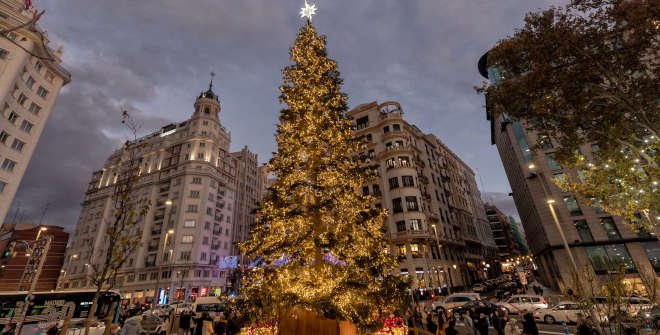
christmas lights
Christmas lights.

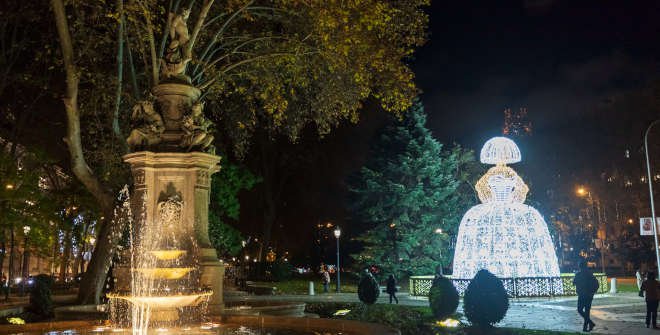
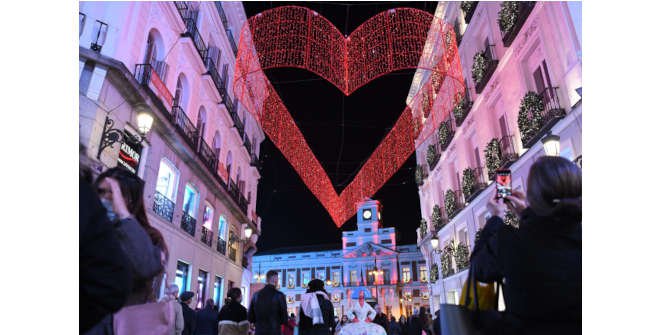
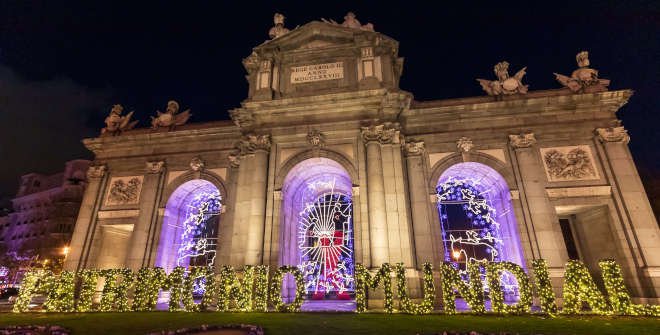
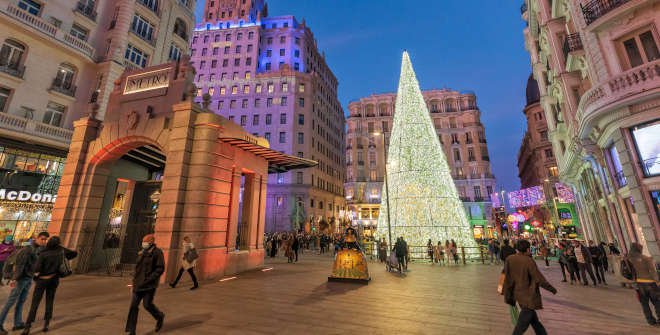
Hello, #vivers! Are you one of those who love Christmas and can't spend December without putting up the tree, the nativity scene and giving gifts to your loved ones? Or is it really not a holiday that excites you? In any case, if you are studying Spanish as a foreign language in Madrid, you may find this entry interesting since, in a matter of days, the city will illuminate its streets with Christmas motifs.

Lights, camera and action!

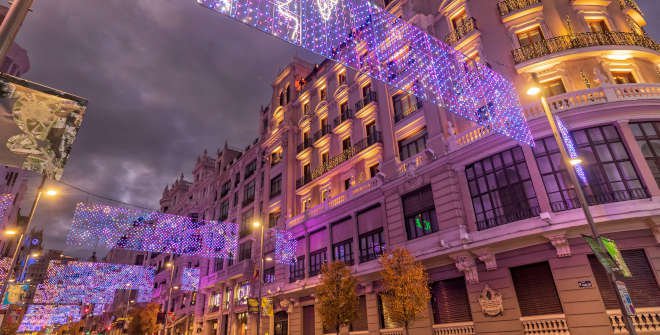
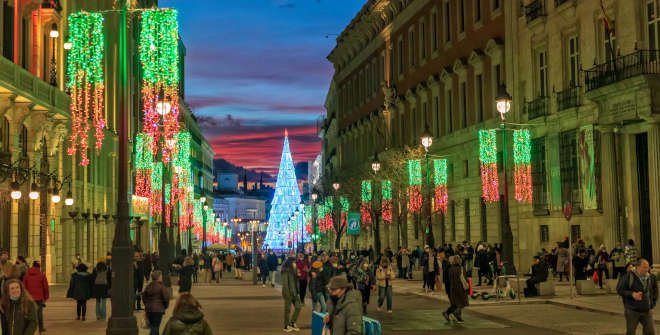
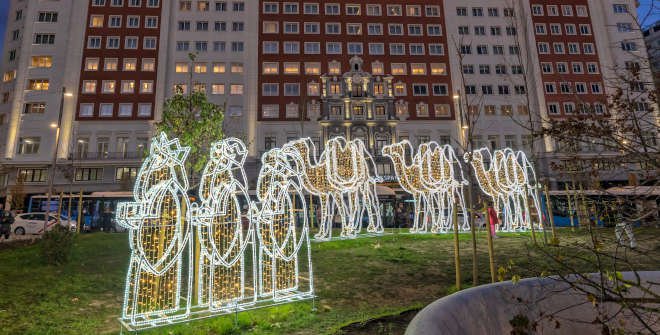
Write this date in your diary, because on November 24 at 19 p.m. the Christmas lights will be turned on throughout the city of Madrid. Streets, squares and buildings will be illuminated with different Christmas designs and decorations. Maybe, if it is not your first year in Spain, you have already seen these lights and can recognize the images and Christmas symbols they represent such as nativity scenes, the three Wise Men, bells, trees, etc. Other times, these are more abstract and avant-garde motifs. Have you ever wondered who is in charge of designing them? Well, we mention some of them.

Light designers.

There are three most notable lighting designers in Madrid:

The first designer is Teresa Sapey, an Italian architect and interior designer. Sapey participates every year in the lighting of Madrid, not only at Christmas but also in other projects. Her works are responsible for illuminating Serrano Street with a colorful forest of light, and the Plaza de Oriente, which has a large Christmas tree.

Ben Busche, German architect and designer. His designs illuminate cities around the world. For him, lighting and decorating is like doing magic, so he makes sure that in his projects the cables are not visible so that the charm is not lost. You can see its lights on numerous streets, such as the most emblematic, Gran Vía.

Sergio Sebastián, our Aragonese countryman. Sebastián has been in charge of lighting such representative streets as Fuencarral Street, Chueca Square or Preciados Street. An architect by profession, Sergio tries to combine his two great passions: architecture and lighting.

Navilight

As in previous years, this year we can once again enjoy the Christmas lights, touring some of the city's most iconic streets on the Naviluz , the Christmas bus. This bus is specially designed to take visitors to the main locations decorated with Christmas lights and motifs. It begins operating on November 25th and will be available until January 6th, with the following schedule:

  • From Thursday to Saturday and holidays from 18:00 p.m. to 22:50 p.m.
  • From Sunday to Wednesday from 18:00 p.m. to 23:00 p.m.

On December 24 and 31, as well as January 5, it does not offer tours.

Tickets cost €7 for general admission and €3 for reduced admission (children aged 3-7 and seniors over 65). Tickets are now available for purchase online at the following link , where you can also find more information:

To take this bus there is only one stop available in Plaza de Colón (next to the Gardens of Discovery).

Of course, if you decide to take the Naviluz tour, we recommend that you dress warmly, with a scarf and gloves! 😉

And if you're thinking of coming to Madrid to see its Christmas lights and take the opportunity to stay and study Spanish as a foreign language, at the Luis Vives Spanish School we offer the Spanish course you need, adapted to all levels and needs. Luis Vives Spanish School. More than lessons!